September 07, 17:30
Vitalik Buterin bets 90% of his net worth AI will not break crypto
Vitalik Buterin now confident AI won't break crypto, betting 90% of his net worth

CryptoSlate
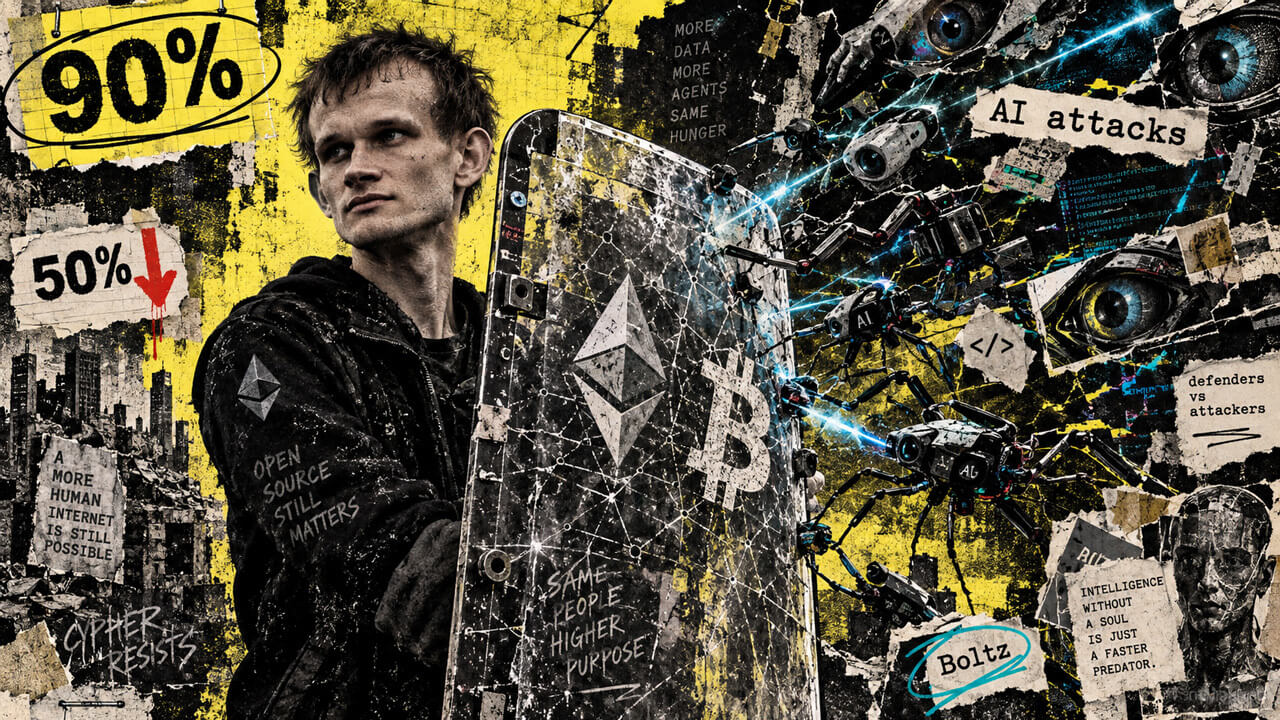
Vitalik Buterin said AI is unlikely to fundamentally break Bitcoin. His existing crypto holdings amount to effectively making the wager with roughly 90% of his net worth. Buterin said Bitcoin should withstand security failures that do not require social consensus. He cited attacks on clients, mining pools and other network infrastructure. He assigned a very low probability to AI causing a fundamental break in Bitcoin's hashing functions or proof-of-work system. Buterin said the same argument should apply to Ethereum. Liron Shapiro said there is a 50% probability that Bitcoin will fall more than 50% over the next two years because AI could undermine investors' security and robustness assumptions. Shapiro's scenario does not require AI to break Bitcoin's underlying cryptography. Attacks that expose weaknesses investors considered difficult or impossible to exploit could damage confidence. In August, Bitcoin swap provider Boltz indefinitely suspended its service. The decision followed months of automated, AI-assisted probing that led to several contained exploits. The probing began moving faster than Boltz's small development team could patch vulnerabilities. Boltz said its non-custodial architecture protected customer funds. The company absorbed losses from the exploits. Boltz concluded that it could no longer safely run the service. The attacks targeted infrastructure surrounding Bitcoin rather than its proof-of-work or core cryptography. Deddy David, chief executive of blockchain security firm Cyvers, said financial exposure from AI-powered crypto attacks could eventually reach hundreds of millions or billions of dollars. David said crypto could be one of the first markets affected if AI identifies vulnerabilities at scale across core internet infrastructure. The risk extends across wallets, bridges, exchanges and smart contracts. It also extends across software used to operate blockchain networks. Anthropic restricted public access to its Claude Mythos model because the model can autonomously discover and weaponize software vulnerabilities. Anthropic directed those capabilities toward defenders through Project Glasswing. Project Glasswing involves technology companies and financial institutions including Amazon Web Services, Google, Microsoft and JPMorgan Chase. The program uses Mythos Preview to identify and repair vulnerabilities in critical systems before malicious attackers find them. Anthropic committed as much as $100 million in usage credits to the effort. More than 100 organizations signed an open letter warning that AI-enabled cyberattacks are likely to become substantially more widespread and sophisticated within months. The signatories said existing cybersecurity practices will not be sufficient as AI systems become more capable. They called for advanced defensive AI and security testing for organizations including hospitals and water utilities. Crypto systems also hold immediately transferable financial assets. Many operate continuously on publicly visible infrastructure. The unresolved question is whether developers can contain attacks through upgrades and stronger defenses before attackers gain a decisive advantage.
This content is an AI-generated summary/analysis for informational purposes only and does not constitute investment advice.