4 hours ago
SEC and CFTC open limited crypto access after CLARITY fails
SEC and CFTC bypass Congress to open crypto access after CLARITY fails - with a catch

CryptoSlate
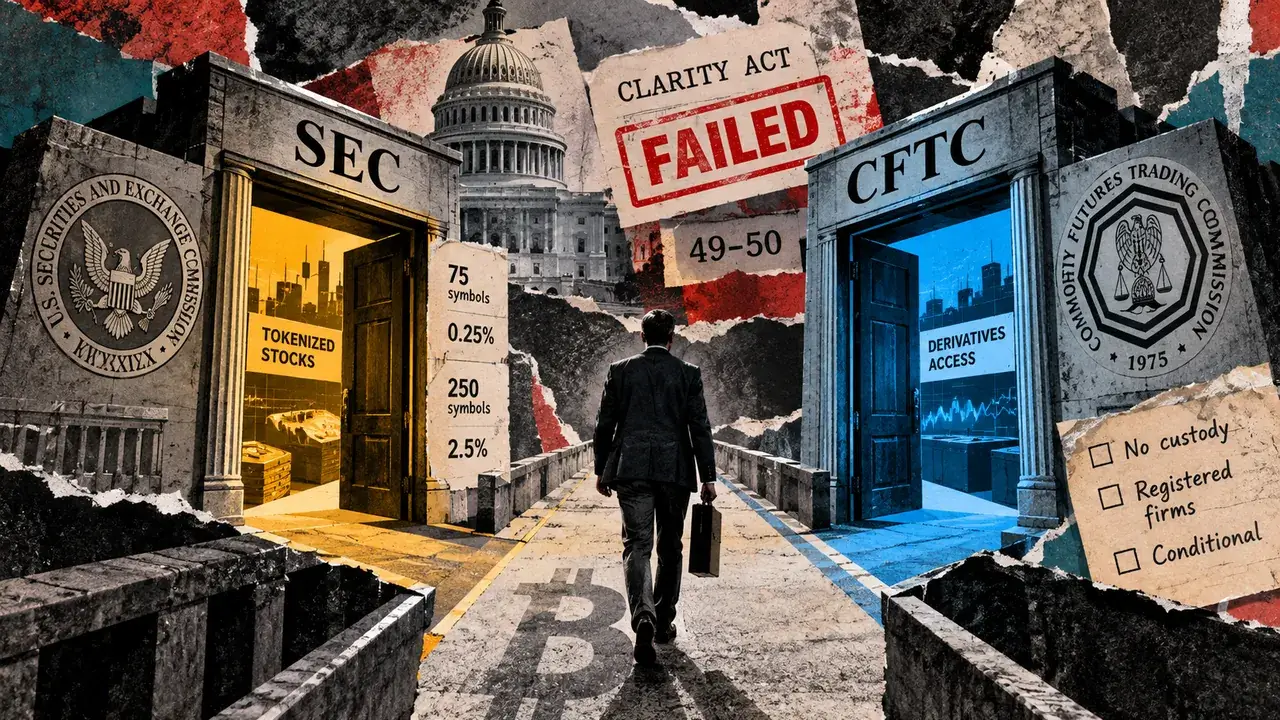
The SEC and CFTC opened two narrower routes for crypto-linked market access under existing law after the Senate failed to advance the CLARITY Act. On Sept. 15, senators voted 49-50 against advancing H.R. 3633. On Sept. 17, SEC Chairman Paul Atkins linked that setback to the Commission's action. Atkins said the SEC was acting under existing statutory authority. He described the exemption as a bridge to durable rulemaking. The SEC order created a Tokenized Securities Venue category. A qualifying venue can bring buyers and sellers together through permissioned automated market maker liquidity pools without being treated as an exchange under the Exchange Act. The exemptions run through Sept. 17, 2031, unless the SEC changes them. Tier 1 stocks are limited to 75 symbols across a TSV and its affiliates. Each Tier 1 stock is also limited to 0.25% of the prior month's average daily share volume. Tier 2 stocks are limited to 250 symbols. Each Tier 2 stock is limited to 2.5% of average daily share volume. Eligible tokenized stocks must preserve the dividend and voting rights of equivalent traditional shares. Synthetic-exposure tokens, rights, warrants, primary issuances and initial offerings do not qualify. A TSV must notify an issuer before trading stock tokenized by an unaffiliated third party. The venue must wait at least 30 calendar days after the issuer receives the notice. An objection within that period blocks trading of the tokenized stock on that TSV. TSVs must set access standards. TSVs must verify participants or wallet addresses. Smart contracts must be public and auditable. TSVs must publish transaction data. TSVs must keep records. TSVs must stop trading when the underlying stock is halted on its primary exchange. Securities Act requirements, federal antifraud and antimanipulation rules and sanctions compliance still apply. The CFTC's Market Participants Division issued Letter 26-25 on the same day. The letter broadens relief previously granted to Phantom in Letter 26-09. Qualifying software providers can display market and position data. They can market particular derivatives contracts and registered firms. They can solicit users. They can receive revenue-sharing or transaction-based fees. They can transmit user-directed orders. The providers cannot hold customer assets. They cannot generate express buy or sell signals. They cannot control order routing or execution. Users must be onboarded directly with a designated contract market, futures commission merchant or introducing broker. Funds securing derivatives positions remain with a derivatives clearing organization or a clearing-member futures commission merchant. Letter 26-25 covers only the division's recommendation on introducing-broker or associated-person registration for the specified activities. It does not create a general exemption from other registration categories or laws. The letter is not binding on the CFTC. The division may modify, suspend or terminate it. No company is named as committed to launch under either pathway. Neither action settles the broader allocation of authority between the SEC and CFTC. Neither action grants an unconditional right to enter the covered markets.
This content is an AI-generated summary/analysis for informational purposes only and does not constitute investment advice.