3 hours ago
Polymarket restores trading after second multimillion-dollar breach in four months
Polymarket suffers second multimillion-dollar security breach in just four months

CryptoSlate
Polymarket resumed trading on Oct. 29 after a compromised third-party provider disrupted the international prediction market. The incident marked Polymarket's second multimillion-dollar security breach in four months. Polymarket's official incident log places the start of trading restrictions at 18:05 UTC and resolution at 19:05 UTC. Polymarket said the problem was fixed and law enforcement had been notified. Polymarket also promised full compensation for affected users.
Bubblemaps, a blockchain analytics firm, estimated that the Oct. 29 breach affected more than 700 Polymarket users and compromised approximately $3.46 million in assets. Attackers exchanged roughly $2.7 million for POL and moved the funds out. Another $750,000 remained on Polymarket when the assessment was made.
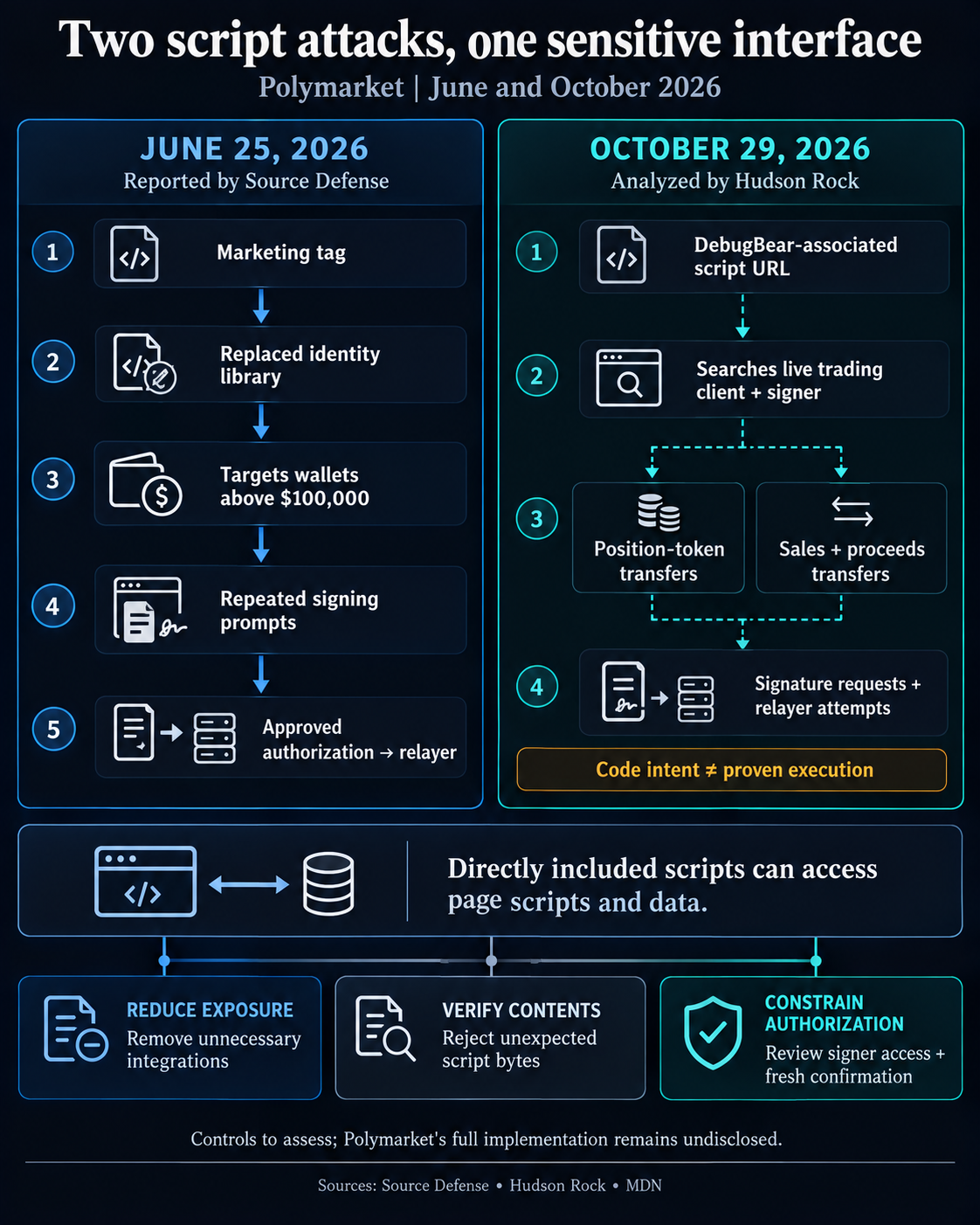
Polymarket disclosed on June 25 that a compromised vendor had enabled the injection of a malicious script. Polymarket said the affected dependency had been removed and promised full refunds. Source Defense reported losses of roughly $3 million from the June attack. Source Defense traced delivery to a marketing tag that fetched an external identity library, which the attacker substituted with a drainer tailored to Polymarket. Source Defense researchers said the June payload targeted wallets holding more than $100,000 and repeatedly sought digital authorization. An approved authorization passed through Polymarket's relayer, which submits signed actions.
Hudson Rock's October analysis described code obtained from a URL associated with DebugBear that sought the active trading client and signer within a logged-in session. The signer is the component that requests cryptographic authorization. Hudson Rock found that the script's programmed behavior varied by account type. One branch requested transfers of position tokens; another requested sales followed by transfers of the proceeds. Hudson Rock also identified production-build metadata documenting removal of the DebugBear monitoring script. However, Hudson Rock's static analysis did not prove that the code executed, obtained signatures silently or stole private keys. The analysis also did not establish a complete trail from victims to recipients. The removal metadata does not establish precisely when users' exposure ended.
The June marketing dependency and October monitoring-associated script provided different routes into a financially sensitive interface. The June mechanism reportedly depended on approved authorizations, while the October code sought trading tools and requested signatures. Replacing a compromised supplier alone does not address the broader problem of malicious code reaching financial functions within the website. The repeated breaches raise questions about the financial authority that outside code can access through a trader's browser.
MDN's browser documentation says a third-party script loaded directly into a page can reach other scripts and data on that page. MDN explains that hosting the script elsewhere does not remove that access, whereas cross-origin content in a separate frame has a different security boundary. Reducing external code, limiting signature requests and checking downloaded files address different stages of the attack chain. Removing unnecessary integrations from trading and signing pages reduces the outside code allowed into those environments. Reviewing signer access and identifying actions that need fresh user confirmation restricts the requests that code can make after gaining access.
Subresource Integrity allows browsers to check downloaded scripts against an expected cryptographic fingerprint and reject altered files. Subresource Integrity can also protect a suitably pinned resource hosted on a trusted domain. A detailed postmortem covering the exposure period, affected accounts and authorization routes would help assess the remaining risk. Whether another compromised integration could convert trading-interface access into usable financial authorization remains unresolved.
This content is an AI-generated summary/analysis for informational purposes only and does not constitute investment advice.