an hour ago
Nasdaq 100 drops more than 4% as Huang's Nvidia return fails to ease AI fears
Market sell-off picks up steam, as Jensen Huang's Nvidia return fails to calm AI fears

NBC News
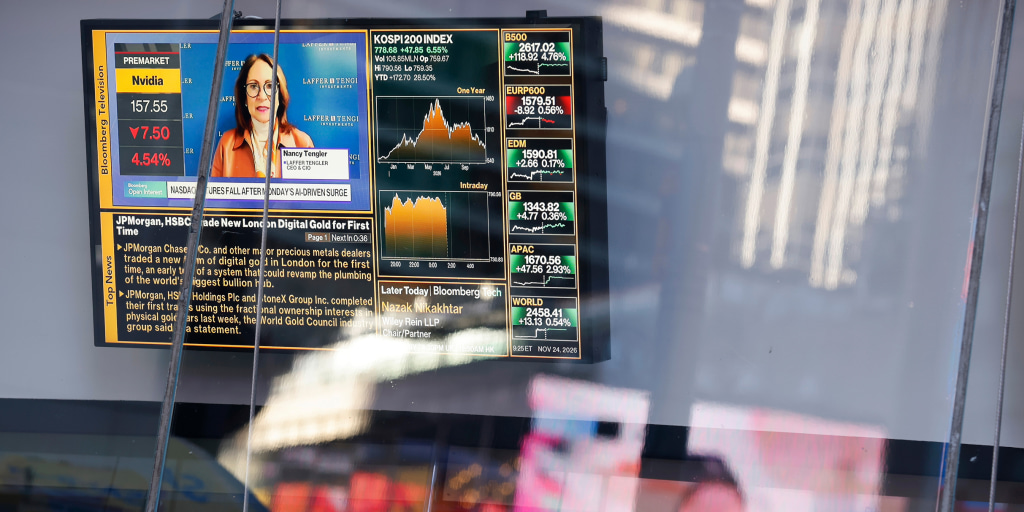
U.S. stocks declined sharply Wednesday, with AI-linked companies leading the losses. The Nasdaq 100 had dropped more than 4% by early Wednesday. The S&P 500 lost nearly 3%. The Dow declined 900 points. Nvidia shares fell 7%. Semiconductor and computer memory shares joined Nvidia among the largest contributors to the decline, with early losses ranging from 7% to 10%.
Wednesday's declines largely eliminated Monday's gains from the strongest one-day market rally since April 2025. Monday's advance lifted the Nasdaq 100 by 6.8%. The S&P 500 gained 4.7% that day. Nvidia, a major AI chip designer, primarily drove Monday's rally by unexpectedly reinstating Jensen Huang as CEO despite an ongoing scandal involving multiple extramarital affairs, including an affair with a woman believed to be a Chinese spy. Huang's return briefly reassured investors that major AI companies could keep expanding without disruption, along with the trillions of dollars those companies borrow and lend.
Weeks of losses before Monday had already put the Nasdaq 100 into correction territory. Wednesday's further decline took the Nasdaq 100 into a bear market, defined as a fall of at least 20% from the latest high. Deutsche Bank strategists said early Wednesday that investors had resumed reducing risk over the preceding 24 hours as Monday's technology-stock recovery weakened. The strategists said the latest losses renewed questions about whether the sell-off would continue.
Frontier AI developer Anthropic further weakened sentiment toward AI as Anthropic's shares continued falling after last week's initial public offering. Anthropic shares ended Friday's debut session more than 17% higher. Three consecutive losing sessions followed that debut. Anthropic shares fell to $78, about 10% below the IPO price. The shares were almost 25% below Friday's closing price.
The approaching Thanksgiving holiday likely added pressure to Wednesday's trading. U.S. markets will close Thursday and trade for half a day Friday. Investors tend to reduce large or risky positions before long weekends to avoid being unable to respond to developments during market closures.
The Trump administration announced another round of tariffs Wednesday targeting major U.S. trading partners, including the European Union, China, Japan and a dozen others. The announcement deepened stock losses amid concerns that additional tariffs could revive trade tensions and inflation after trade-policy tensions had eased in recent months. Deutsche Bank strategists said the latest tariff developments added to market pressure. ING senior trade economist Inga Fechner argued that U.S. protectionism was becoming harder to reverse despite changing legal grounds for tariffs. Before Wednesday's formal announcement, China's commerce ministry criticized the duties as "political manipulation" and said tariff and trade wars served neither side's interests. Evercore ISI international political affairs chief strategist Sarah Bianchi said new tariffs arising from the Section 301 overcapacity investigation had been a question of timing, not likelihood, although some investors might have been surprised.
The Personal Consumption Expenditures index, the Fed's preferred inflation measure, rose to 3.8% for October from 3.6% in September, moving farther from the Fed's 2% target. Core inflation, which excludes food and energy, increased to 3.3% from the previous month's 3.1%. Rising core inflation can signal to economists that higher energy costs are spreading through the broader economy. The inflation increase also makes a Fed rate increase more likely at the next meeting, which ends with a decision on December 9. Fed Governor Christopher Waller expressed strong concern in a CNBC interview last week that inflation was worsening and spreading. Waller urged more aggressive action, including a 0.50% rate increase rather than the usual 0.25%, saying the Fed might need to "shock people".
Technology companies worth trillions of dollars are borrowing hundreds of billions of dollars to develop AI data centers and chips. Higher interest rates could quickly increase those companies' already substantial costs. Mortgage rates remain well above 7%. A rate increase could also burden already struggling U.S. consumers by raising borrowing costs for auto loans, credit cards, personal loans and other credit.
This content is an AI-generated summary/analysis for informational purposes only and does not constitute investment advice.