11 hours ago
US orders DeepSeek removal from federal systems as company opens AI infrastructure
US orders DeepSeek purge from federal systems as Chinese AI rival opens its technology to the world

CryptoSlate
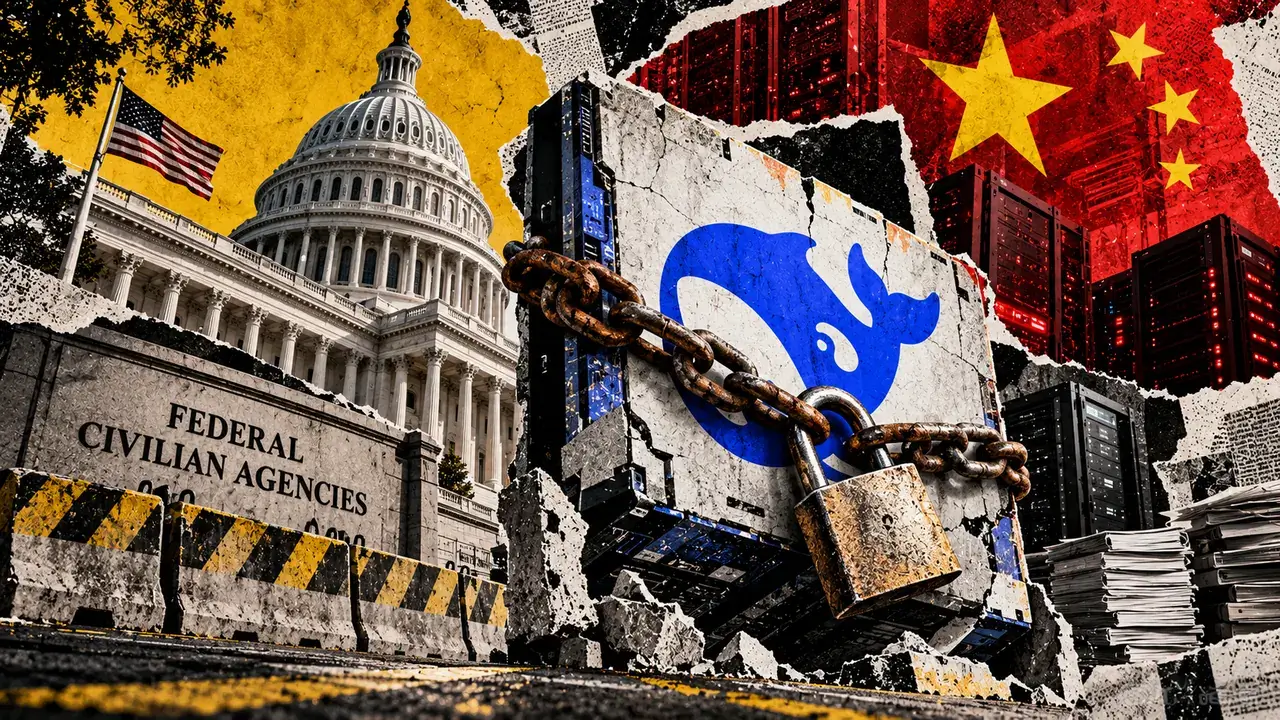
The US government ordered federal civilian agencies to remove DeepSeek technology from their information technology systems and prohibited future purchases. The restrictions also cover software and services developed by other companies using DeepSeek implementations. The Department of Homeland Security (DHS) published the directive on Oct. 20. Homeland Security Secretary Markwayne Mullin originally signed the order on July 24 under the Federal Acquisition Supply Chain Security Act of 2018. Agencies were required to begin complying immediately, with a 60-day window to request exceptions.
DHS cited national security concerns about DeepSeek's operations in China, including the possibility that government employees could enter sensitive information that could reach servers in China. DHS also warned that DeepSeek technology could contain security vulnerabilities. DHS warned that information collected through DeepSeek services could provide intelligence on American government activities. The restrictions follow earlier actions against DeepSeek by the Commerce Department, the US Navy and several state governments. China condemned the decision, accusing Washington of politicizing technology and undermining commercial cooperation between the world's two largest economies.
The order creates compliance obligations for federal technology suppliers, which must assess whether products incorporating DeepSeek implementations can continue serving government customers. Affected contractors may need to replace DeepSeek components or seek exemptions, potentially benefiting competing AI providers. The restrictions threaten DeepSeek adoption among federal contractors and technology suppliers.
DeepSeek announced on Oct. 20 that DeepSeek had open-sourced DeepInfer, the inference framework powering the company's large-scale artificial intelligence services. The release gives developers access to technology previously used internally to operate DeepSeek models. DeepInfer includes optimized computing kernels, distributed inference capabilities, speculative decoding and processing tools designed to improve throughput and reduce the computing resources needed to generate AI responses. DeepSeek also released deepseek-recipe, a collection of software components for token encoding, prompt formatting and API request processing. The tools allow independent developers to reproduce key elements of DeepSeek's API behavior when running DeepSeek models. Company engineer Cui Tianyi said the releases aim to enable more businesses and organizations worldwide to deploy and profit from DeepSeek technology.
The release expands DeepSeek's open-source strategy beyond publishing model weights and gives developers greater control over infrastructure used to run AI systems. The release could expand DeepSeek's global reach. The release could also strengthen DeepSeek's appeal among businesses seeking less reliance on proprietary AI services from OpenAI, Anthropic and Google. Those providers' flagship production-serving infrastructure remains largely closed.
DeepInfer currently supports DeepSeek-V4.1-Flash, a 552-billion-parameter model introduced in September. DeepSeek-V4.1-Flash activates only a fraction of the model's parameters for individual tasks. DeepSeek said the model's architecture requires substantially less memory and storage for inference caching, allowing providers to process more requests using fewer computing resources. DeepInfer is distributed under the Apache 2.0 license, which permits commercial modification and redistribution. DeepInfer supports Nvidia SM100 graphics processors and Huawei Ascend 950 chips, giving developers options across American and China-based computing hardware. Compatibility with Huawei processors could support China's efforts to develop domestic AI infrastructure amid US restrictions on advanced semiconductor exports.
The initial DeepInfer release provides offline inference capabilities. However, operators must still supply components such as cache management and load balancing to build a complete production service. The release allows cloud providers and businesses outside the US federal market to run DeepSeek models on their own infrastructure, customize the technology and reduce AI operating costs. However, hosting DeepSeek technology on private infrastructure would not automatically exempt a product from the federal order, which expressly covers third-party implementations.
This content is an AI-generated summary/analysis for informational purposes only and does not constitute investment advice.