September 21, 12:30
ZetaChain votes to retire its blockchain for a Solana AI pivot
This blockchain just voted to shut itself down for a Solana-powered AI pivot

CryptoSlate
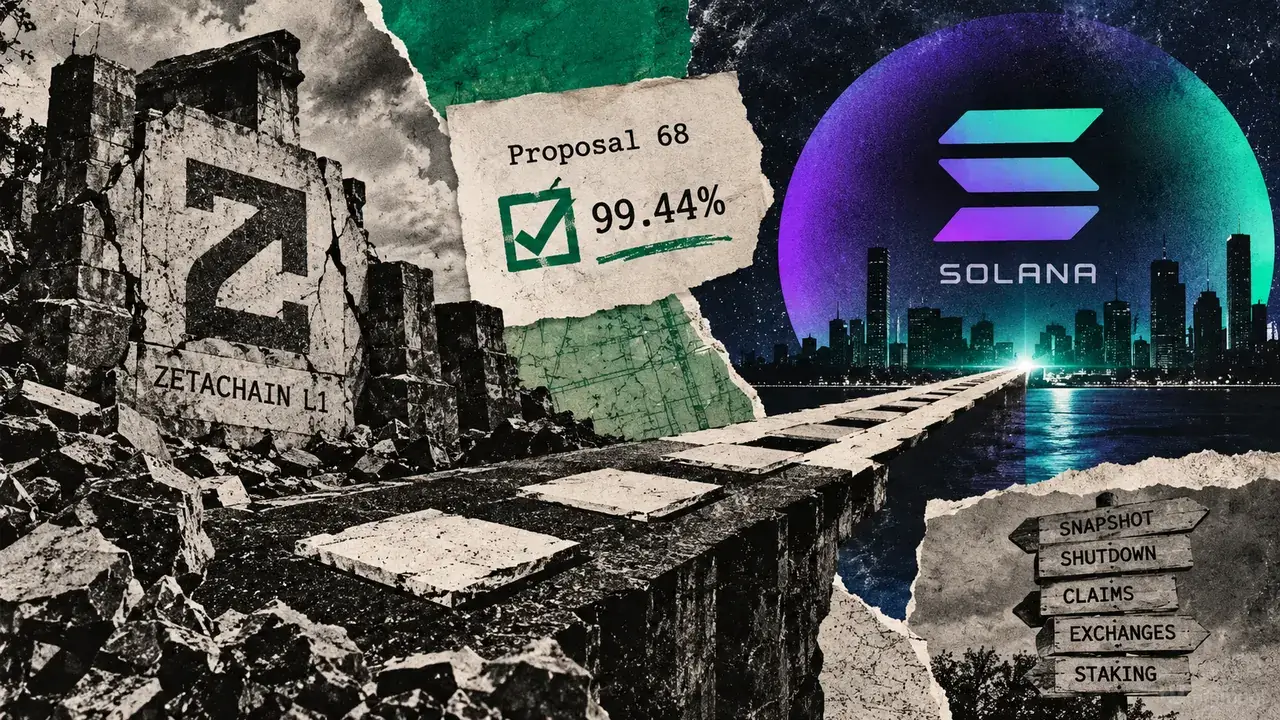
ZetaChain's on-chain governance approved Proposal 68 to retire the project's standalone blockchain and move ZETA to Solana as ZetaChain focuses on private AI. Voting ended Sept. 20, with about 99.44% of ballots supporting the plan. The tally showed 263.65 million ZETA voting in favor, 744,658 voting against and 752,300 abstaining. The vote gives core contributors a mandate to prepare the migration, but it does not immediately move tokens or shut down the network. A second governance vote must set the migration date, exchange conversion process, staking model and shutdown mechanics. ZetaChain was founded in 2021 to connect separate blockchains and spent years building a Cosmos SDK-based layer-1 for applications using assets and contracts across networks including Bitcoin, Ethereum and Solana. The project later began concentrating resources on Anuma, a private multi-model AI application built around what it calls a Private Memory Layer. ZetaChain says maintaining its own blockchain no longer supports that effort because operating a Cosmos-based network requires coordinating security advisories and patches across dozens of independent validators. The project expects that operational burden to grow as AI tools make vulnerabilities easier to find. ZetaChain says moving to Solana would replace that validator infrastructure and let contributors focus on Anuma and development on Solana. It said every contributor hour would shift toward ZETA, Anuma and Solana development. ZetaChain says Anuma has attracted more than 300,000 users since February and processed more than 1 million requests across 35 AI models. Each Anuma account includes a wallet, so the migration could bring those users into the Solana ecosystem alongside ZETA. ZetaChain argues that Solana provides the transaction speed, low fees, liquidity and emerging agent-payment infrastructure needed for AI applications that may make frequent payments or model calls. It cited confirmations of about 400 milliseconds, more than $15 billion of stablecoins on Solana and roughly $70 billion in monthly decentralized-exchange volume. Under the planned migration, native balances on ZetaChain would convert 1:1 into a Solana-native SPL token under the same ticker. Total supply would remain unchanged, and no additional tokens would be created. After the migration is completed, the Solana token would become the canonical version of ZETA and ZetaChain's layer-1 would wind down. ZetaChain is positioning ZETA as an access token for its AI products rather than primarily as the asset underpinning an independent proof-of-stake network. Anuma already lets users lock ZETA in exchange for credits used for AI services, removing those tokens from circulating supply. ZetaChain wants other AI applications and agents on Solana to use the same system. The strategy depends on whether Anuma can turn its early user growth into sustained demand and whether outside developers adopt ZetaChain's memory layer. The migration would give ZETA access to Solana's larger trading and payments ecosystem, while removing the independent blockchain that previously formed the center of the token's utility. ZETA held on Ethereum and BNB Chain is outside Proposal 68, and existing vesting schedules would remain unchanged. Native balances moving from ZetaChain would shift from 18 decimal places to Solana's nine and be rounded down. The first proposal does not specify how fractional remainders would ultimately be treated. Core contributors said they will submit the second governance proposal only after centralized exchanges confirm how they intend to support the swap. Major exchanges require advance notice for token migrations, so the shutdown timetable depends on those negotiations rather than a predetermined date. The follow-up proposal is expected to establish the withdrawal window for assets still connected to ZetaChain, the snapshot and halt heights, when Solana claims begin, how exchange-held balances convert, holder protections and the validator wind-down process. Rewards will continue until the layer-1 shuts down, while ZetaChain says it is still exploring what staking could become after ZETA moves to Solana. ZetaChain will continue operating its existing infrastructure until exchanges agree on the mechanics and token holders approve them.
This content is an AI-generated summary/analysis for informational purposes only and does not constitute investment advice.