September 26, 12:30
Kalshi must block some state users after Sixth Circuit ruling
Kalshi must lock out state users after major court loss

CryptoSlate
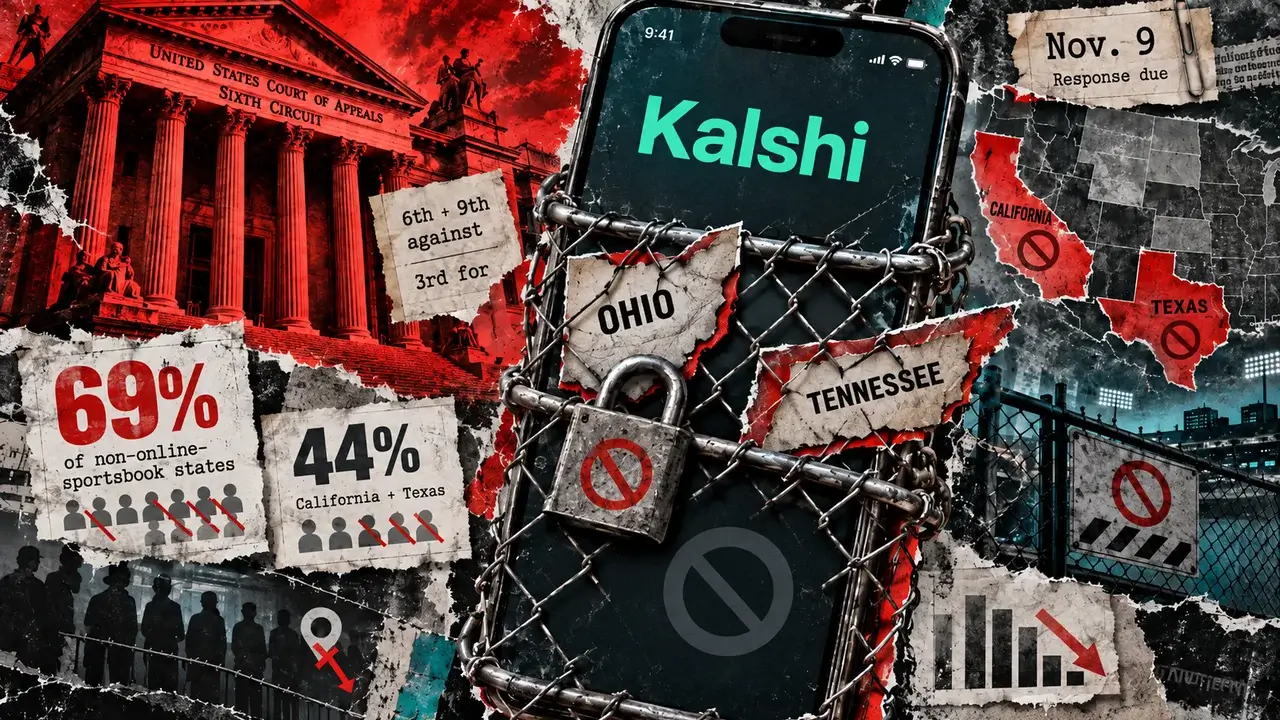
The Sixth Circuit ruled on Sept. 25 that Ohio and Tennessee can apply their gambling laws to Kalshi's sports contracts. The ruling requires Kalshi to block sports-contract access where state laws bar it. Eilers & Krejcik Gaming estimates that 69% of Kalshi's retail sports demand comes from states without legal online sportsbooks. The unanimous panel held that Kalshi had not shown that its sports contracts meet the Commodity Exchange Act's definition of a swap. The court also held that state gambling laws would remain in force even if the contracts were swaps. The court affirmed an Ohio ruling against Kalshi. It vacated the preliminary injunction that had shielded Kalshi from enforcement in Tennessee. It sent both cases back to the lower courts. The decision applies to federal courts in Ohio, Tennessee, Michigan and Kentucky at the preliminary-injunction stage. The court rejected Kalshi's argument that federal duties requiring impartial access and national order matching make geographic restrictions impossible. The panel said those duties apply to the markets an exchange chooses to list. The panel identified geofencing as a way to comply with federal exchange rules and state gaming laws. Kalshi told the court that geographic access controls would be technically difficult, time-consuming and expensive. The judges responded that expensive does not mean impossible. A Michigan state-court injunction issued on Sept. 1 requires Kalshi to keep covered sports contracts unavailable to users located in Michigan. The users must be verified through a qualifying third-party geolocation provider. Violations can bring penalties of up to $500,000 a day. Eilers & Krejcik Gaming estimates that California and Texas account for 44% of Kalshi's retail sports demand. The firm estimates that prediction markets displaced 2% to 4% of sportsbook handle in the most competitive legal betting states. More than 90% of Kalshi's trades in 2025 involved sports contracts. Sports contracts generated 95% of its revenue in 2025. A restriction covering half of the non-sportsbook footprint would affect geography representing about 34.5% of Eilers & Krejcik Gaming's modeled retail sports demand. California is within the Ninth Circuit, which ruled against Kalshi's preemption argument in Nevada on Aug. 28. Texas is within the Fifth Circuit, which has not ruled on the question. Ohio and Tennessee have legalized sports wagering and regulate it through age, geographic, licensing, tax and consumer-protection rules. The Sixth Circuit said states collected more than $3.2 billion in sports-gambling tax revenue in fiscal 2025. DraftKings says its prediction product serves California and Texas even though its sportsbook is unavailable there. FanDuel says its prediction product offers sports contracts in states where online betting is illegal and will withdraw them when conventional sportsbooks become legal. Eilers & Krejcik Gaming counted $31.1 billion in US sports prediction-market execution volume through Sept. 20 in the third quarter. The firm reported that Polymarket's US exchange reached roughly 22% of sports-contract volume in September. The Third Circuit sided with Kalshi in New Jersey in April. The Ninth Circuit and Sixth Circuit have ruled against Kalshi's preemption argument. A Fourth Circuit appeal involving Maryland remains pending. New Jersey asked the Supreme Court on Sept. 2 to resolve the circuit split. Kalshi's response is due Nov. 9 after a Sept. 22 extension. The Supreme Court has not decided whether to hear the case. If the Supreme Court adopts the Third Circuit's interpretation, sports contracts could remain available nationwide under one federal rulebook. If reasoning from the Sixth and Ninth circuits spreads, Kalshi could face state-by-state permissions, licensing, tax, age and geolocation requirements. Eilers & Krejcik Gaming projects $279 billion in sports prediction-market execution volume in 2027. Kalshi would remain a CFTC-regulated exchange offering economic and political markets across the country.
This content is an AI-generated summary/analysis for informational purposes only and does not constitute investment advice.