September 26, 20:20
SEC staff addresses legal hurdle as crypto buybacks reach record $638 million
SEC clears regulatory hurdle as crypto token buybacks hit record $638 million

CryptoSlate
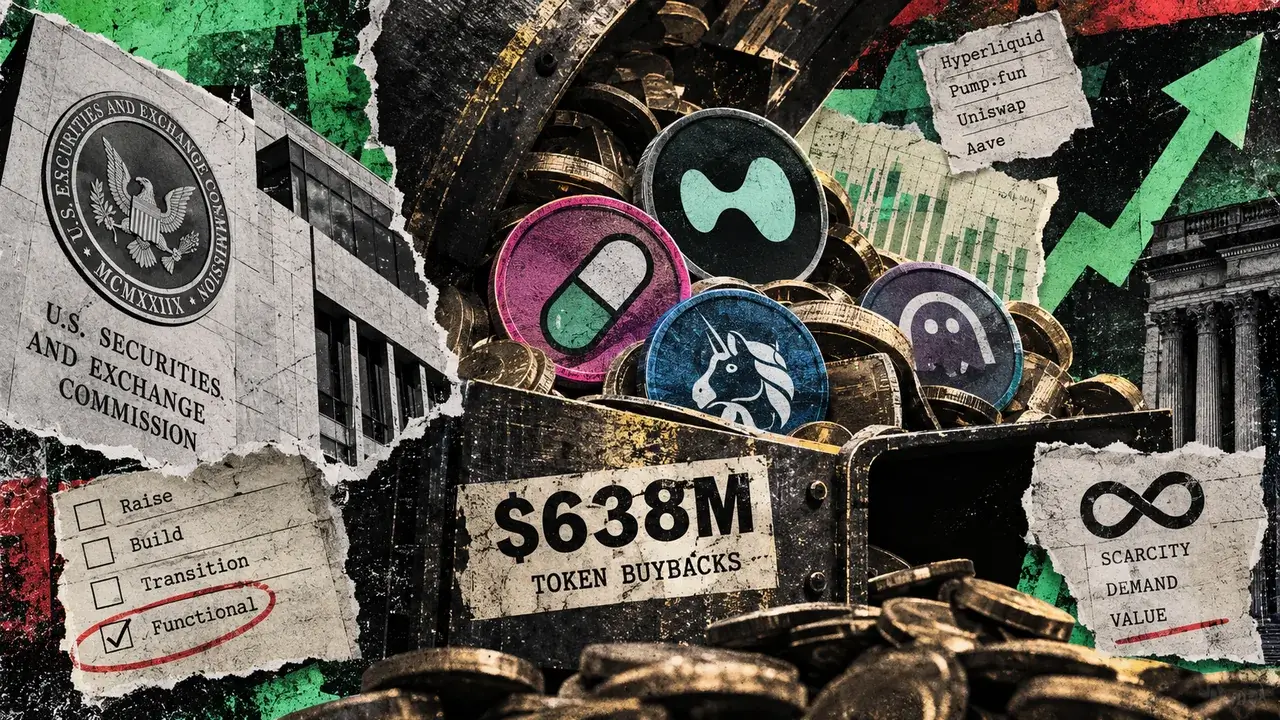
SEC staff addressed the legal treatment of crypto buybacks as projects spent about $638 million through late August 2026. That spending set a record, up from $545 million over the same period in 2025. Hyperliquid accounted for roughly $370 million. Pump.fun accounted for about $200 million. The two projects represented nearly 90% of the total. On Sept. 25, the SEC's Division of Corporation Finance issued crypto FAQs covering functional networks. Staff said an issuer's buyback announcement for a non-security crypto asset on a functional network falls outside the promises of essential managerial efforts at the center of the Howey test. Staff warned that presenting a buyback as a source of yield or returns can contribute to an investment-contract analysis on a network that is not yet functional. The guidance assumes that the network is functional and that the token is already outside securities law. The SEC said the staff views have no legal force. Under the SEC's March interpretation, a network is functional when its native token can be used according to its programmed utility. The same interpretation says a token can be sold as part of an investment contract while a team raises money through promises of managerial work. The proposed Regulation Crypto Assets rule would let projects raise up to $5 million over four years under a startup exemption. A larger exemption would allow up to $75 million every 12 months. Both exemptions would include disclosure requirements. Proposed Rule 400 would add a Form TR transition filing. An issuer would use the form to certify on EDGAR that it completed or permanently ceased its promised managerial efforts. The issuer would also certify that it stopped making new managerial promises. The SEC could later contest whether the conditions were met. The SEC estimates that about 475 issuers a year could rely on the safe harbor. That estimate is based on 15% of roughly 3,165 projects launched in 2024. Comments on the proposal close Oct. 20. The Form TR would cover projects that abandoned their roadmaps and projects that completed them. The buyback FAQ would apply only after a network became functional. Pump.fun says it uses half its revenue to buy and permanently burn PUMP. Its dashboard shows roughly $500 million in annualized revenue. The dashboard shows about $462.5 million in cumulative purchases. It also shows 167.7 billion tokens destroyed, equal to 16.8% of the original supply. The article says Pump.fun's current allocation implies around $250 million in annual purchases. That amount equals about 6.4% of Pump.fun's displayed $3.91 billion fully diluted valuation. Hyperliquid has bought and burned roughly $1.3 billion of HYPE since launch. Hyperliquid's documentation says more than $1 billion in annualized fees now flows into programmatic HYPE purchases. Uniswap activated protocol fees on Ethereum mainnet in December 2025. Uniswap later extended the fees to other chains. Outside searchers can collect accumulated fees only by burning UNI in exchange. Hyperliquid funds staking rewards from a reserve of future emissions. Trading fees burn HYPE. A protocol that burns 5% of supply and issues 8% through emissions and unlocks dilutes holders despite a large buyback. Aave acquired more than 205,000 AAVE for roughly $42 million during its first ten months. The purchases represented about 1.28% of supply. Governance debated cutting the annual budget from $50 million to $30 million as revenue softened. The DAO paused purchases on April 19 after the rsETH bridge incident to preserve balance-sheet flexibility. S&P 500 companies spent $1.02 trillion on repurchases in the 12 months through September 2025. Crypto buybacks rose from about $366,000 in 2024 to $638 million in less than eight months of 2026. Uniswap's documentation says UNI holders receive value through the burn mechanism and future mechanisms approved by governance. Protocol revenue remains under the protocol's control. The SEC's March interpretation describes digital commodities as assets whose holders lack an inherent right to passive yield, future income, or profits. Governance can redirect or pause a buyback program. The SEC lists Bitcoin as a digital commodity. Bitcoin has no issuer or protocol revenue to recycle. If the SEC finalizes Regulation Crypto Assets close to its current form, projects could use the exemptions, complete finite roadmaps, file transition reports, and direct revenue into token purchases after their networks become functional. Hyperliquid's fee flows and Pump.fun's allocation indicate industry buybacks above $1 billion a year at current run rates. If the proposal stalls or takes a weaker form, the nonbinding staff FAQ would remain the main source of regulatory comfort. Revenue-linked programs shrink when revenue falls. A major exploit or bad-debt event could cause treasuries to conserve funds. Buybacks would remain revocable and governance-dependent without creating a contractual claim for holders.
This content is an AI-generated summary/analysis for informational purposes only and does not constitute investment advice.