September 19, 10:40
Brazil bars stablecoins from one cross-border payment leg from Oct. 1
Brazil blocks stablecoins from key cross-border payment rail as $1.1 trillion market faces new limits

CryptoSlate
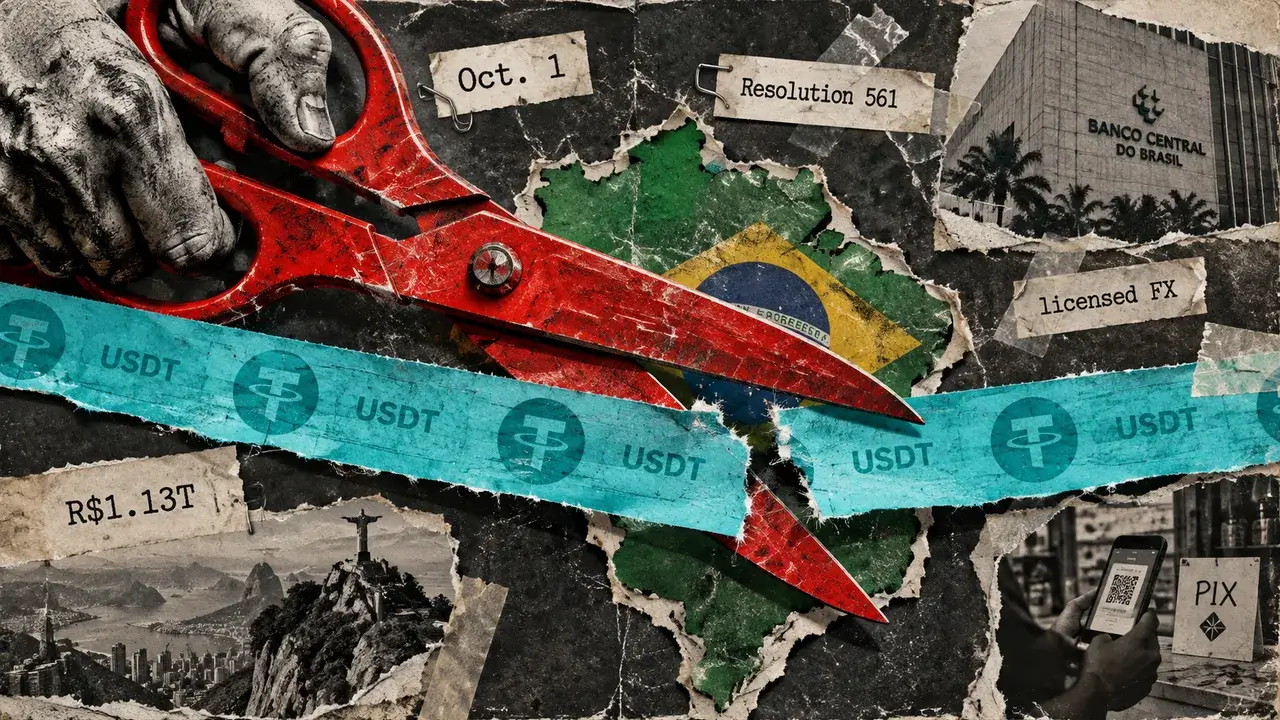
Brazil's central bank will bar virtual assets, including stablecoins, from settling one specific type of international payment flow from Oct. 1. Resolution 561 applies to the settlement leg between regulated foreign-exchange providers and their overseas counterparties. That leg must instead use a licensed foreign-exchange transaction or a qualifying non-resident real account. Individual international transfers using virtual assets remain permitted under Brazil's existing framework. Oscar Guillermo Farah Osorio, founding partner at Zanella & Farah, said the resolution closes an ambiguity left by Brazil's 2022 virtual assets law, which authorized the central bank to determine which crypto operations qualify as foreign-exchange activity without providing specific rules. Providers can still aggregate and net individual payments before settling with foreign counterparties through permitted channels. Farah said the prohibited combination is stablecoin settlement with bulk aggregation, which he argued provided much of the cost advantage. Conventional FX conversions could incur Brazil's financial transaction tax, while correspondent-bank and SWIFT-network fees could also apply. Farah expects those costs eventually to reach Brazilian consumers and businesses. Brazil's tax authority recorded R$1.13 trillion in declared stablecoin transactions between August 2019 and December 2025, representing roughly 72% of all declared crypto activity during that period. Stablecoins accounted for close to 80% of declared volume in 2025, and USDT represented nearly 89% of that stablecoin total. A July Bank of Italy study of 200-dollar USDC transfers across ten international corridors, including Brazil, found total costs ranging from 0.3% to nearly 9%, with no consistent advantage over conventional payment channels. The study did not examine Resolution 561 specifically. It found that blockchain transfers made up only a marginal share of total costs, while currency conversion and local payment infrastructure accounted for most expenses. Transfers took under 20 minutes where instant payment systems existed and took one or two business days elsewhere. The Financial Stability Board reached a similar conclusion in July. Cregis CEO Shawn Yan said brokers are using stablecoins for treasury management, liquidity transfers between entities and internal settlement that is not visible to end clients. Yan said brokers can keep wallets and treasury controls in-house where permitted and route specific payment legs through licensed intermediaries where required. He said the core business remains foreign exchange and that regulatory restrictions are changing the underlying infrastructure rather than the business itself. Yan said firms cannot base their models on one assumption about how stablecoins will be treated in every jurisdiction. Farah questioned why individual international stablecoin transfers remain permitted while aggregated eFX transfers do not, particularly if regulated providers could provide the same transaction data to the central bank. He interpreted the rule mainly as an effort to keep flows within channels the central bank can already monitor and control, rather than as a change in how regulators conceptually classify stablecoins. The article presents one possible outcome in which larger firms obtain permissions, partner with licensed institutions and build standardized compliance systems, while stablecoins continue to support treasury management and cross-border liquidity outside the restricted eFX leg. It also presents a downside in which added FX, banking and correspondent costs reduce stablecoins' advantage for Brazil-linked flows and make separate infrastructure too costly for smaller payment firms.
This content is an AI-generated summary/analysis for informational purposes only and does not constitute investment advice.