October 01, 12:20
Daines bill would exempt eligible stablecoin purchases from capital gains tax
Senate tax bill frees stablecoin spending while Bitcoin stays on IRS forms

CryptoSlate
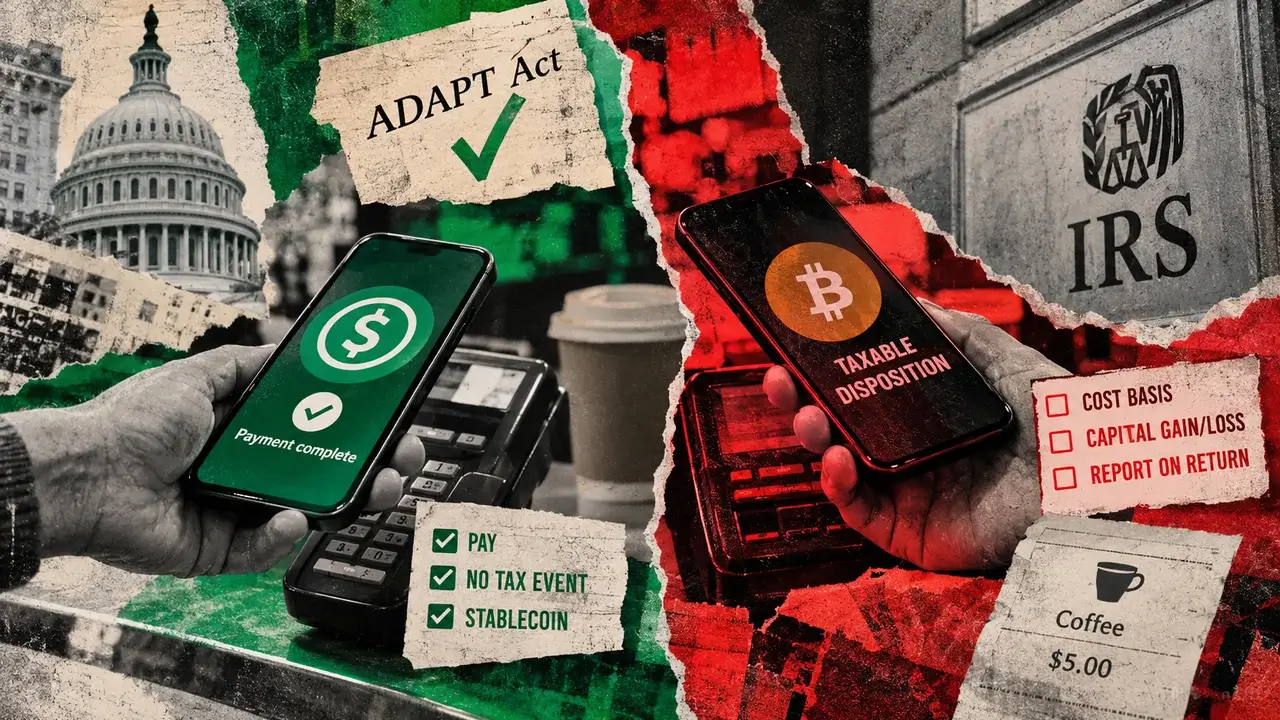
Sen. Steve Daines released the proposed Aligning Digital Assets with Principles of Taxation Act on Sept. 30. The 56-page text lists Sens. Cynthia Lummis, Bernie Moreno and Tim Scott of South Carolina as cosponsors. Bloomberg Law reported on Sept. 25 that Daines had circulated a draft and expected to introduce it the next week. Under current IRS guidance, paying for goods or services with digital assets in any amount is a disposition. Holders of personal or investment assets must calculate and report capital gain or loss based on the asset's value and cost basis. A payment can produce a gain, a loss or a break-even result. In an IRS coffee-purchase example, a $5 Bitcoin payment with an allocated basis of $3 produces a $2 reportable capital gain. The bill's proposed section 1034 would exempt gain or loss on covered payment stablecoins used to buy products or services. Sales taxes and other purchase obligations would still apply. A covered token must be a qualified U.S. dollar stablecoin issued by a permitted payment stablecoin issuer under the GENIUS Act. A foreign issuer could qualify through OCC registration or a Treasury finding that its home regulatory regime is comparable. The stablecoin must appear in Treasury's most recent report before payment. The taxpayer must also have acquired the token at a price within 3% of $1.00. Treasury would publish a report at least every three months listing qualified stablecoins actively traded within 3% of $1.00 during the 12 months ending the prior month. Traders, brokers and dealers in qualified dollar stablecoins would be excluded from the exemption. Taxpayers using a functional currency other than the dollar would also be excluded. Treasury could extend the trade-or-business exclusion to similar businesses. Taxpayers would have to keep records distinguishing eligible payments from other transactions. Covered payments would be exempt from broker information returns under section 6045(i)(1). Brokers could rely on customer certifications without verifying the acquisition-price test for tokens bought elsewhere. The stablecoin exemption would apply to transactions entered into starting Jan. 1, 2027. Bitcoin payments to merchants would remain taxable dispositions under the proposal. Proposed section 1044 would exempt coins used to pay digital asset transaction costs from gain-or-loss recognition if the aggregate value used for those costs is $10 or less. Base, gas and priority fees would count as costs, and related transactions would be aggregated. The fee exemption would exclude traders, brokers, dealers, businesses that batch or help validate others' transactions, and assets under mark-to-market accounting. Anyone who initiated more than 5,000 digital asset transactions in the prior taxable year would also be excluded. The fee exemption would apply to dispositions starting Jan. 1, 2027. For a Bitcoin purchase, a qualifying network fee could receive relief while the Bitcoin sent to the merchant would remain taxable. The bill would also exempt qualified dollar stablecoins from wash-sale and constructive-sale rules that it extends to other digital assets. Sen. Ted Budd's S.4171, introduced March 24, would require both a qualifying transaction's value and its otherwise recognized gain or loss to be $200 or less. Budd's proposal would aggregate related transactions and exclude certain transactions, including business-property and cash-equivalent exchanges. Lummis's S.2207, unveiled in July 2025, sets a $300 ceiling on both transaction value and recognized loss, with no further exclusions once qualifying annual gains exceed $5,000. The House PARITY Act proposed a $200 threshold for stablecoin transactions. H.R.10357 was introduced Sept. 14, and the House Ways and Means Committee announced its approval by 38-5 on Sept. 16. That House proposal uses stablecoin redemption-value accounting and qualifying $10 fee relief as distinct mechanisms; committee approval precedes any House vote. All these measures remain proposals, and current IRS treatment remains in force. The Daines bill leaves Treasury to establish details of its list, recordkeeping and broker reporting rules, while token eligibility would depend on issuer approvals under the GENIUS Act.
This content is an AI-generated summary/analysis for informational purposes only and does not constitute investment advice.